
Al Hussein Technical University qualifies to the Solar Decathlon final
19/02/2023
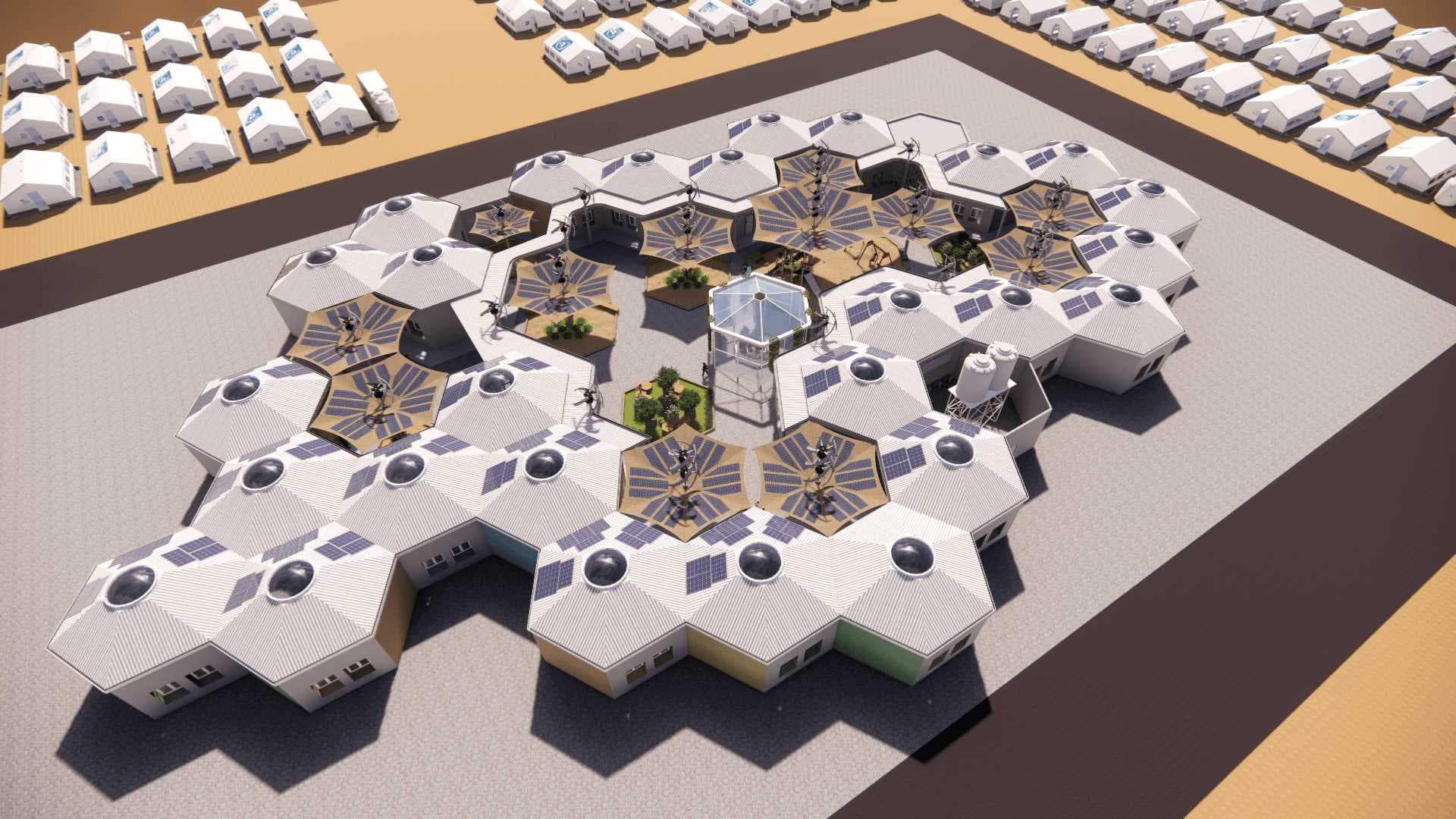
Al Hussein Technical University and the University of North Texas have made it to the final stage of the Solar Decathlon competition, which is organized by the United States Department of Energy. HTU is considered one of only three Arab universities that participated, and the only Arab university that made to the final. This competition challenges students worldwide to design a zero-energy buildings while the team chose to design an educational building for refugees in three different camps; Zaatari in Jordan, Cox's Bazar in Bangladesh (the largest in the world), and Bugnido in Ethiopia, which are home to more than 80,000, 900,000, and 50,000 refugees. Where the Al Hussein Technical University team consists of Razan Telfah, Layna Al-Sughair, Laith Al-Bdour, Faris Odaibat, AbdelRahman Abu Adas, Yasmeen Masalha, Salma AlZoubi, and Ahmad Abdullah, whose majors vary between architecture, mechanical engineering, and computer science. While Adaa for Sustainable Development Consulting is represented by Engineer Maysoon Al-Khraisat, Engineer Rania Al-Zyoud, and Engineer Omar Hamad as an industry partner. The students were tasked with designing an educational building that is zero-energy, sustainable, and adaptable to the needs of the refugee community. The team's role focused on the architectural design of the building, energy and renewable energy systems, and mechanical systems, so they used available materials and local resources in each camp, which helped keep costs low and used known construction techniques, such as the team’s use of plastic bottles filled with sand in the internal and external wall units to provide thermal insulation, reduce waste, and create a durable and earthquake-resistant structure. The team also conducted a general climate analysis to determine the annual data of temperature, precipitation, and wind for each site. This helped them determine the appropriate renewable energy sources to incorporate into construction, including solar panels and wind turbines. By incorporating renewable energy sources, the building will be able to generate its own electricity and power adjacent spaces within the camp, ending the reliance on traditional energy sources. Moreover, the team designed a building that created an inclusive community system with the ability to adapt based on the specific requirements of each site and they studied the needs of the community. So, the building provides all the needs for the children, including classrooms, clinic, workshop, library, laboratories, canteen and recreational space, as well as an agricultural greenhouse that will help provide food for the students and enable them to learn how to grow crops and provide for their community. The team's design is based on a grid system that uses a medium-sized hexagonal modular design, which allows modules to be increased and decreased more easily as required, thus ensuring the design's adaptability. The team's design is based on a grid system that used a medium-sized 28 hexagon unit design, which allows units to be placed on different levels and at different scales to meet the requirements of any given site, confirming the design's scalability and adaptability. The achievement of Al Hussein Technical University and the University of North Texas team demonstrates their ability to create innovative solutions to complex problems and contribute to improving the lives of refugees. The final stage of the Solar Decathlon competition will take place soon on the 20th of April, and the team hopes to continue their success and create a lasting impact in the lives of those they aim to serve. This project is a testament to the power of collaboration, innovation, and empathy, and it serves as an inspiration to other teams and organizations around the world.