HTU Hosts a Series of Lectures on Astronomy and Space Technology in Collaboration with the Regional Center for Space Science and Technology Education for Western Asia
20/12/2022
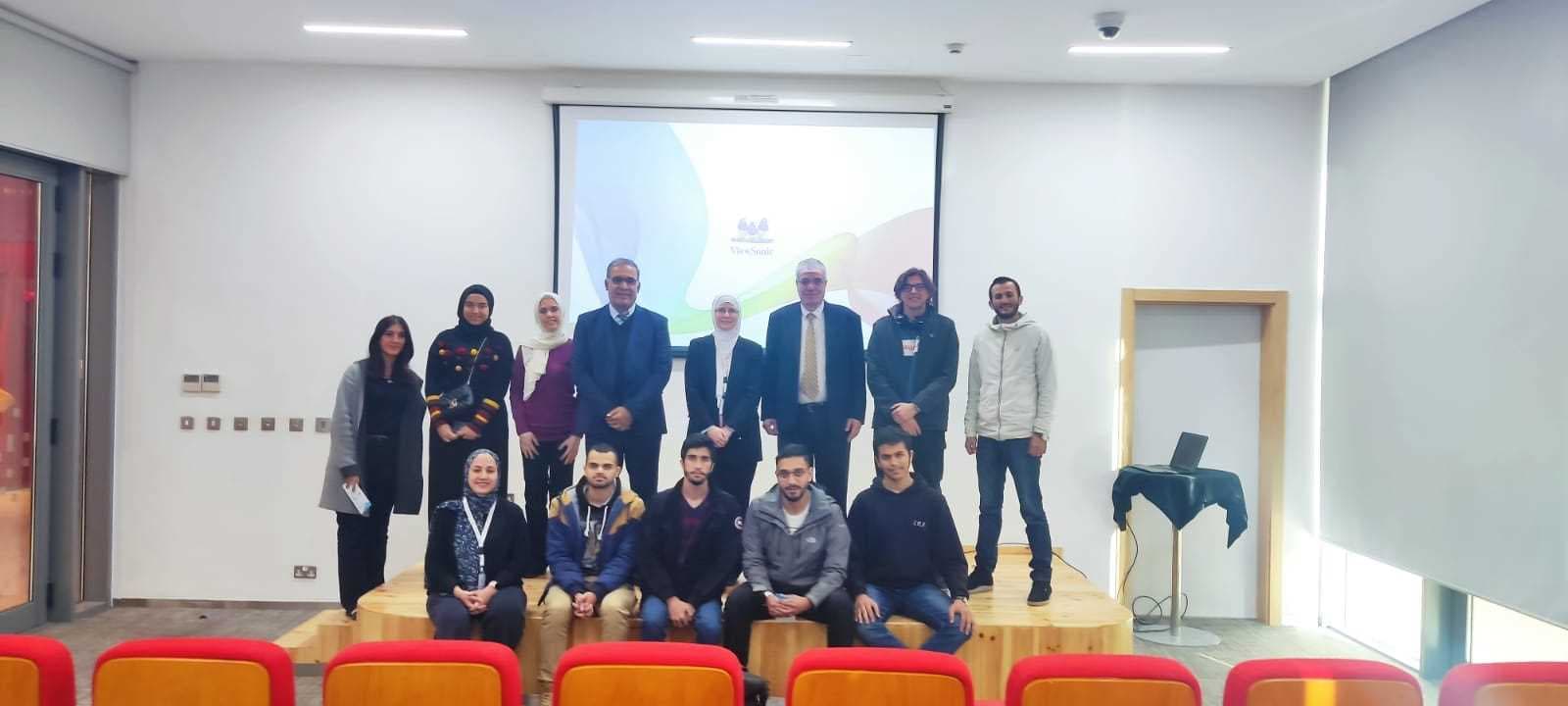
As part of the Regional Center for Space Science and Technology Education for Western Asia’s strategy to promote awareness and understanding of astronomy and space sciences within the local community—particularly among university and school students—the Center’s Directorate of Academic Affairs, under the guidance of its Director General, Brig. Eng. Moammar Kamel Haddadin, organized a series of lectures at Al Hussein Technical University (HTU) in collaboration with the university’s Deanship of Student Affairs. The sessions took place on Tuesday and Wednesday, December 20–21, 2022, on HTU’s campus.
On the first day, Dr. Hanna Sabbat, Director of Academic Affairs at the Center, delivered a lecture titled “A Journey Through the Universe.” He introduced participants to key information carriers in astronomy—such as electromagnetic waves, cosmic rays, neutrinos, and gravitational waves—before discussing the structure and components of the universe, from the solar system and the Milky Way to galaxy clusters, quasars, and the large-scale structure of the cosmos. Dr. Sabbat also highlighted how these cosmic elements interact, form, and evolve, touching on phenomena like solar winds and geomagnetic storms, which significantly impact modern systems including power grids, communications, and satellites.
On the second day, Dr. Ammar Al-Sukaji, Head of the Academic Programs and Research Department at the Center, presented a lecture titled “The Importance of Space Science and Technology.” He explored the role of space technologies in daily life and their contributions to fields such as medicine, communications, and environmental protection. Dr. Al-Sukaji explained how studying the physical properties of other planets has led to advancements in solar panel development, imaging technologies, and climate research, including understanding global warming. He also showcased images captured by the James Webb Space Telescope, emphasizing how these discoveries have deepened scientists’ understanding of previously mysterious cosmic phenomena.
The final lecture, presented by Dr. Qais Al-Omari, Head of the Training Department at the Center, was titled “Applications of Space Technology in Sustainable Development.” Dr. Al-Omari introduced the audience to UN-affiliated regional centers and their mission to advance the United Nations’ 17 Sustainable Development Goals (SDGs). He demonstrated how space technologies—through specialized satellites for water research, agriculture, Earth observation, and atmospheric monitoring—play a vital role in achieving these goals. Dr. Al-Omari also emphasized the importance of introducing space science and technology education in schools and universities, particularly in developing countries, as the future is increasingly intertwined with advancements in these disciplines.
The lectures were attended by HTU students, Prof. Lutfi Al-Sharif, Vice President of the University, Dr. Mariam Al-Baltawi, Dean of Student Affairs, and several faculty members.
At the conclusion of the sessions, an engaging discussion took place between the speakers and students, who expressed great enthusiasm for learning more about astronomy and space technology, calling for more educational events of this kind in the future.